



The 2nd SJTU Microeconomics Symposium Convenes at Antai College for SJTU’s 130th Anniversary 2026-06-01
Hosted by Antai College of Economics and Management, Shanghai Jiao Tong University (SJTU) and organized by its Department of Economics, the Second SJTU Symposium on Microeconomics took place on SJTU’s Xuhui Campus from May 22 to 24, 2026. As one of the flagship academic events marking SJTU’s 130th founding anniversary, the symposium brought together leading microeconomic theorists from prestigious universities worldwide for in-depth exchanges on cutting-edge research spanning information economics, mechanism design, industrial organization, contract theory and organizational economics.
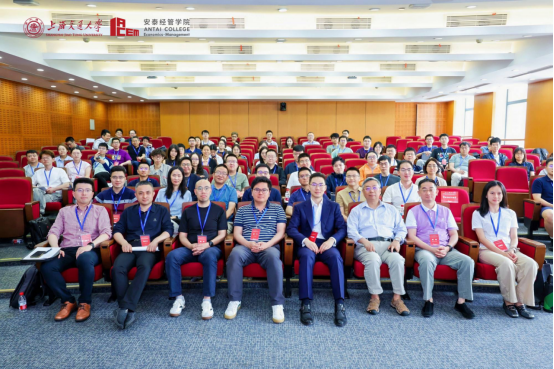
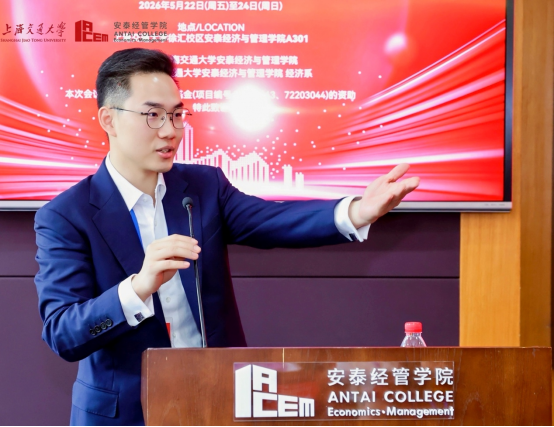
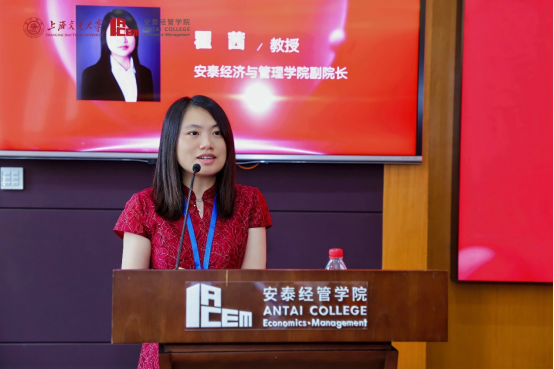
The symposium commenced with an internal roundtable discussion on the evolution of microeconomic theories on the afternoon of May 22. Its formal opening ceremony was hosted by Assistant Professor Min Weicheng on the morning of May 23. Professor Qu Xi, Vice Dean of Antai College, delivered the welcome address, extending a warm reception to all attending scholars and outlining the college’s growth path alongside the background and academic value of the conference.
Session 1: Information Economics & Industrial Organization (Morning, May 23)
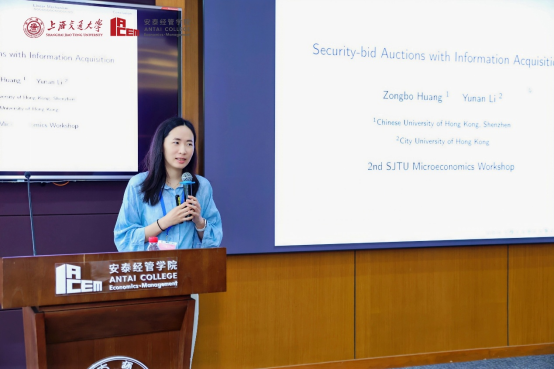
Yunan Li (City University of Hong Kong) presented Security-bid Auctions with Information Acquisition. His research finds steeper security payoff structures reduce the marginal return of information acquisition and may curb auction proceeds. Under a revenue-maximizing linear mechanism, winning bidders settle in cash if their expected asset valuation exceeds a predefined threshold and via equity otherwise; this threshold falls alongside rising marginal costs for enhancing information precision. Empirical findings are consistent with the paper’s theoretical predictions.
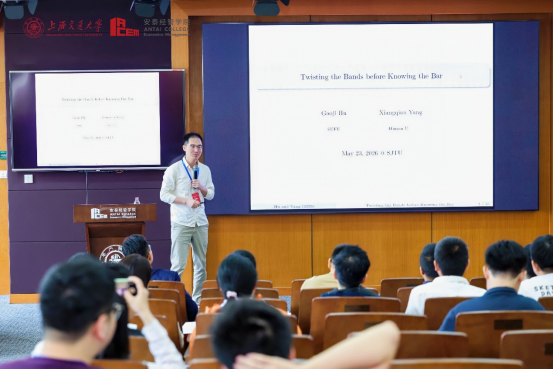
Gaoji Hu (Shanghai University of Finance and Economics) discussed Twisting the Bands before Knowing the Bar, which addresses how information designers set optimal signal structures absent full knowledge of the principal’s allocation thresholds. Optimal design entails partial pooling of agent types, with pooled intervals possibly positioned at the upper end, middle range, or absent entirely depending on threshold distribution. Relevant applications span job matching, doctoral admissions and professional qualification certification.
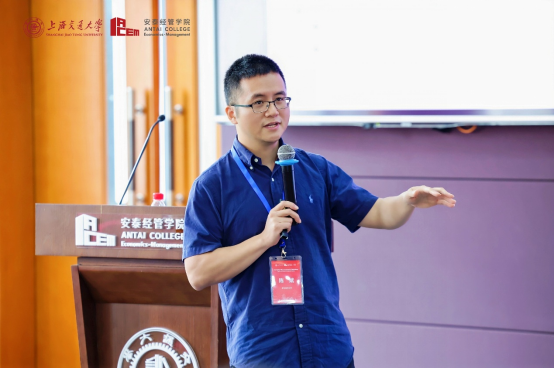
Bin Chen (Huazhong University of Science and Technology) delivered a presentation on Behavior-based Pricing with Correlated Buyers. Departing from canonical theory, the study verifies correlated consumer preferences may either mitigate or amplify the ratchet effect, rendering dynamic purchase-history pricing superior or inferior to static pricing in profitability. In market equilibrium, consumer surplus and aggregate social surplus vary non-monotonically with the buyer correlation coefficient.
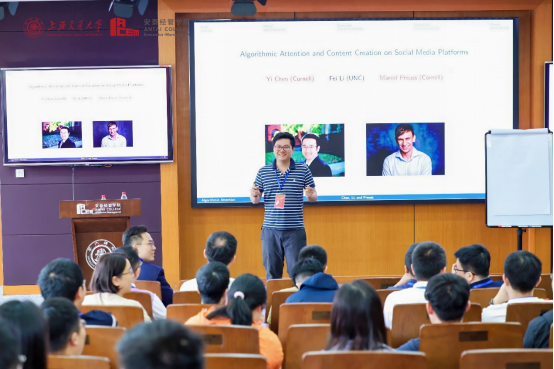
Fei Li (University of North Carolina at Chapel Hill) analyzed Algorithmic Attention and Content Creation on Social Media Platforms. The optimal content recommendation algorithm eliminates low-productivity creators while over-allocating user attention to high-performing creators to strengthen content-generation incentives. Restricted from targeted recommendations, platforms adopt stricter content screening, driving certain niche content out of the market. Platforms with robust advertising profitability prefer cash subsidies over attention-based incentives for creators.
Session 2: Contract Theory & Mechanism Design (Afternoon, May 23)
Jianpei Li (University of International Business and Economics, UIBE) explored Efficient Contracting in Expert Markets. Under capitation payment, experts consistently invest in diagnostic efforts yet may decline services for high-risk clients; fee-for-service yields efficient resource allocation at low diagnostic costs but can trigger full market breakdown when diagnosis becomes costly. If experts retain pricing autonomy, hybrid payment mechanisms may underperform standalone schemes. Provider co-payment provisions restore expert diagnostic incentives where regulated treatment prices fail to do so.
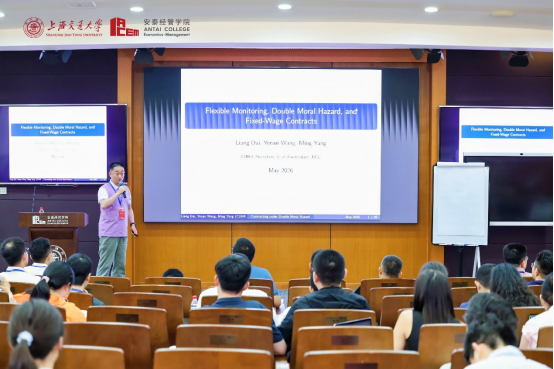
Liang Dai (The Chinese University of Hong Kong, Shenzhen) presented Flexible Monitoring, Double Moral Hazard, and Fixed-Wage Contracts. Within an infinite-horizon framework with bilateral moral hazard, the optimal contract follows an efficiency-wage fixed-pay format: employment terminates promptly upon verified underperformance, and the principal devotes all monitoring resources to identifying poor outcomes. Even a single-period credible monitoring commitment enables performance-based compensation and improves overall economic efficiency.
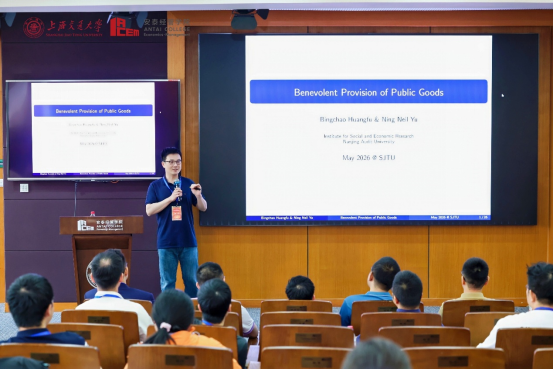
Ning Yu (Nanjing Audit University) discussed Benevolent Provision of Public Goods. By embedding Confucian benevolence-driven altruism into a standard public-good game, the research disproves the conventional consensus that wealth redistribution cannot lift public goods supply: shifting endowments toward more prosocial agents raises aggregate provision and achieves strict Pareto improvements.
Yifei Sun (UIBE) presented Correlated Equilibrium Implementation: Navigating toward Social Optima with Learning Dynamics. The paper establishes a necessary and sufficient condition: a social choice function can be fully implemented via finite mechanisms under correlated equilibrium if and only if it satisfies Maskin monotonicity. This implementation holds even when agents update choices via regret-minimization learning without access to counterparts’ private preferences or equilibrium information. The proposed mechanism withstands minor informational shocks and outperforms existing benchmarks in convergence speed, resource efficiency and allocation performance in numerical simulations.
Session 3: Information Economics & Mechanism Design (Morning, May 24)
Fan Wu (Peking University) spoke on Incentivizing Information Acquisition. In a principal-agent setup where agents incur costs to improve signal accuracy, the optimal incentive scheme follows a threshold rule: agents earn a fixed lump-sum reward only when submitted reports closely approximate the underlying true state, receiving no compensation otherwise.
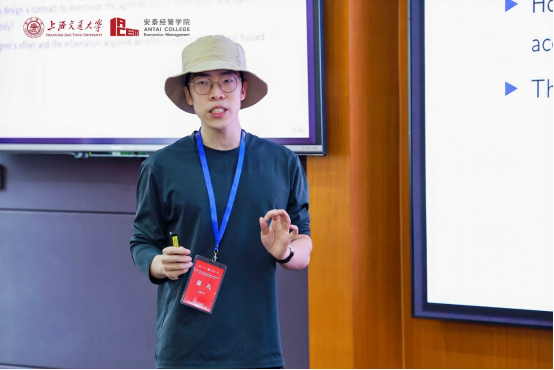
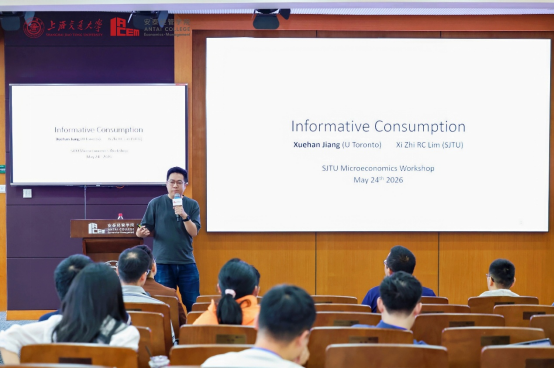
Xizhi Lin (Shanghai Jiao Tong University) presented Informative Consumption. The research quantifies informational gains embedded in risky consumption and splits standard certainty equivalence into conventional risk premium and a newly defined information premium. The parsimonious two-parameter model separately gauges risk aversion and information-seeking motives, explaining heterogeneous individual risk-taking decisions across markets.
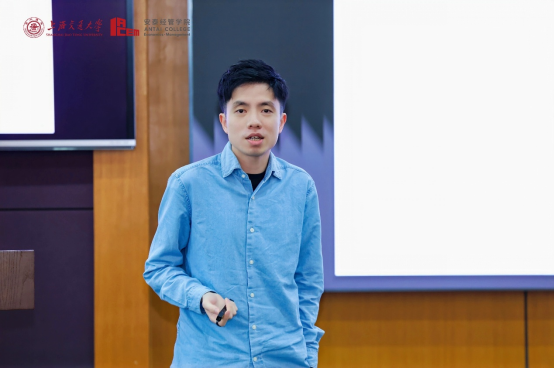
Jiangtao Li (Singapore Management University) discussed Ascending Auctions and Rank Guarantees. For multi-bundle combinatorial ascending auctions with profit-maximizing sellers, the study derives a rigorous lower bound on auction revenue: proceeds are no less than the (|M|+1)-th highest bidder valuation across all available bundles when bidders avoid strictly dominated strategies. Total revenue shortfall is decomposed into losses stemming from incomplete bundle menus and bidder coordination failures.

Allen Vong (National University of Singapore) presented Task Assignment as Dynamic Incentives. The optimal dynamic task rotation policy relieves high-performing agents from onerous assignments while retaining underperformers to continue tasks. Even with fully symmetric agents across all payoff dimensions, incentive concerns endogenously create differentiated task rankings and unequal treatment; monitoring intensity impacts the principal’s bottom line non-monotonically.
Session 4: Organizational Economics (Afternoon, May 24)
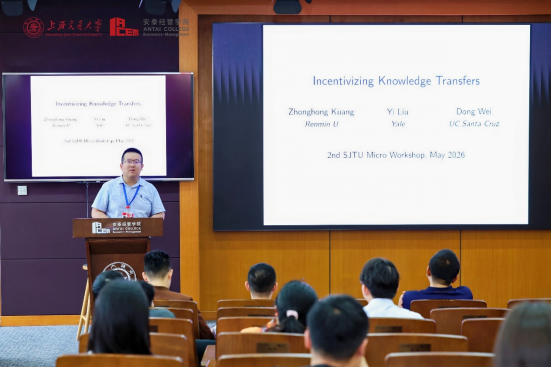
Zhonghong Kuang (Renmin University of China) examined Incentivizing Knowledge Transfers. Third-party principals deploy relational contracts to motivate seasoned specialists to pass proprietary know-how to junior recruits. The optimal dynamic scheme features free preliminary training followed by gradual incremental knowledge transfer, with one-off compensation disbursed post-verification of each transfer milestone. Complete knowledge diffusion is unattainable even under infinitely repeated cooperation. This theoretical framework rationalizes landmark cross-border technology transfer cases in China’s automotive industry and South Korea’s high-speed rail sector.
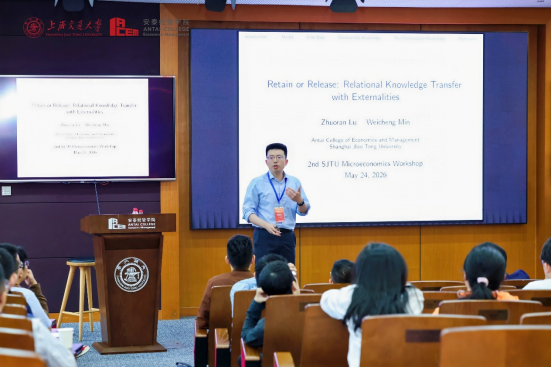
Zhuoran Lu (Shanghai Jiao Tong University) presented Retain or Release: Relational Knowledge Transfer with Externalities. Additional knowledge transfer boosts in-house production efficiency during cooperation yet inflates agents’ outside options and generates adverse post-separation competitive externalities. When knowledge transfer is legally enforceable, accumulation follows an exponential growth path; if non-contractible, steep retention costs may entirely halt knowledge sharing, while low retention costs lead to full transfer albeit at distorted speeds. Though unfavorable for experts ex ante, negative externalities strengthen their bargaining credibility and raise final payoffs ex post.